The Roluos Group temples represent a pivotal era in Khmer history, showcasing the architectural prowess and religious devotion of the early Khmer Empire. These magnificent structures, located near present-day Siem Reap, Cambodia, offer a fascinating glimpse into a kingdom that would later build Angkor.
Bakong: The First Mountain Temple
Bakong, the earliest major temple in the Roluos Group, was likely constructed in the late 9th century during the reign of King Indravarman I. This five-tiered pyramid, built in the style of a mountain, exemplifies the transition from earlier brick architecture to the use of sandstone. 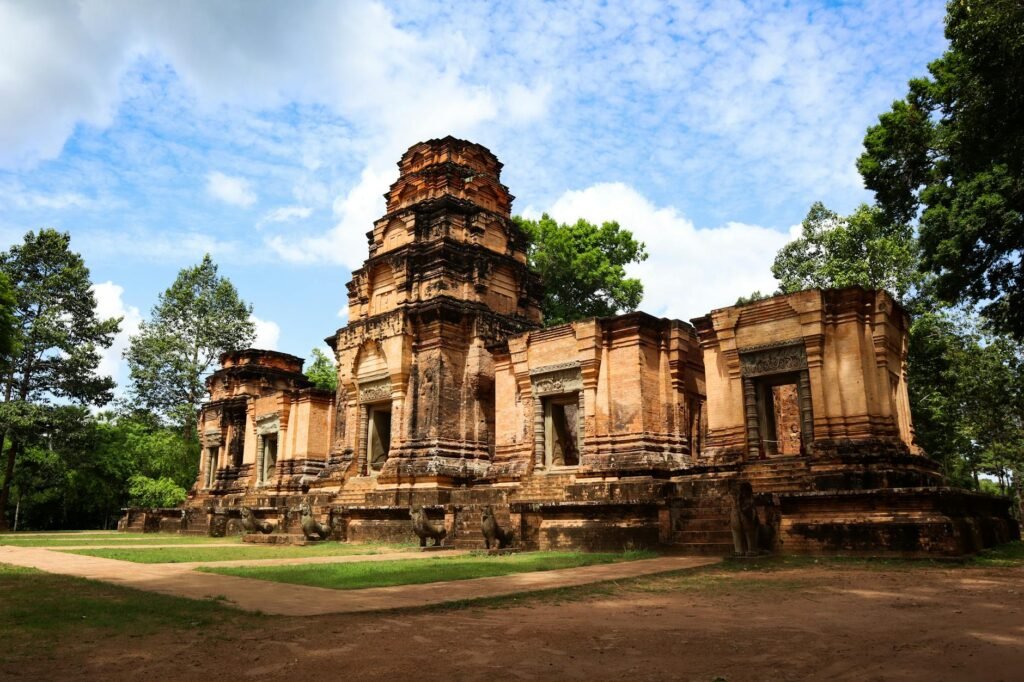 Its design may have been influenced by Indian religious concepts, and the temple played a significant role in the royal consecration ceremonies. Learn more about the Khmer Empire’s religious practices.
Lolei: The Mysterious Temple
Lolei, another key structure in the Roluos Group, is known for its unique design. Its three concentric galleries, each with a central sanctuary, are less clearly defined than other Khmer temples. The purpose of Lolei is still debated among scholars.  Some believe it served as a state temple, while others suggest it had a more specialized function. Its architectural style is strikingly different, hinting at potential influences from outside the Khmer realm. Read more academic interpretations of Lolei’s purpose.
Preah Ko: The Sacred Oxen
Preah Ko, meaning ‘Sacred Oxen,’ is perhaps the most well-preserved of the Roluos Group temples. Built by Indravarman I’s successor, King Yashovarman I, it features beautifully carved lintels and pediments depicting scenes from Hindu mythology. [IMAGE_3_HERE] The temple is dedicated to the king’s ancestors, emphasizing the importance of royal lineage and the continuity of power. You can explore the intricate details of the carvings up close. Discover more about Khmer stone carving techniques.
The Significance of the Roluos Group
The Roluos Group temples are not only remarkable for their architectural ingenuity but also for their historical importance. They represent a critical stage in the development of Khmer art and architecture, setting the stage for the later grandeur of Angkor Wat. The temples also reveal the evolving religious beliefs and political structures of the early Khmer Empire. Studying them helps us understand the foundation upon which the later Angkorian civilization was built. [IMAGE_4_HERE] Explore the evolution of Khmer architecture.
Visiting the Roluos Group Today
Today, the Roluos Group temples are a popular destination for visitors to Cambodia. They are a quieter alternative to the more crowded Angkor Wat complex, offering a more intimate and reflective experience. You can easily reach them by tuk-tuk or car from Siem Reap. Remember to dress respectfully when visiting religious sites. Check out travel guides for Siem Reap.
Conclusion
The Roluos Group temples stand as silent witnesses to the rise of the Khmer Empire. These structures offer a valuable window into the artistic, religious, and political landscape of early Angkor. They represent a fascinating chapter in the rich history of Cambodia and should not be missed by any visitor interested in Southeast Asian history and culture. Learn more about Cambodian history.
Frequently Asked Questions
What is the best time to visit the Roluos Group? The dry season (November to April) offers the most pleasant weather for exploring the temples.
How much time should I allocate to visiting the temples? Allow at least half a day to fully appreciate the sites.
Are there guided tours available? Yes, many local guides offer tours of the Roluos Group.
Is it easy to get to the Roluos Group from Siem Reap? Yes, it’s easily accessible by tuk-tuk or taxi.
What should I wear when visiting the temples? Dress modestly, covering your shoulders and knees.